
The 3 Levels of AI Adoption — And Why 90% of Companies Are Stuck in Tier 1
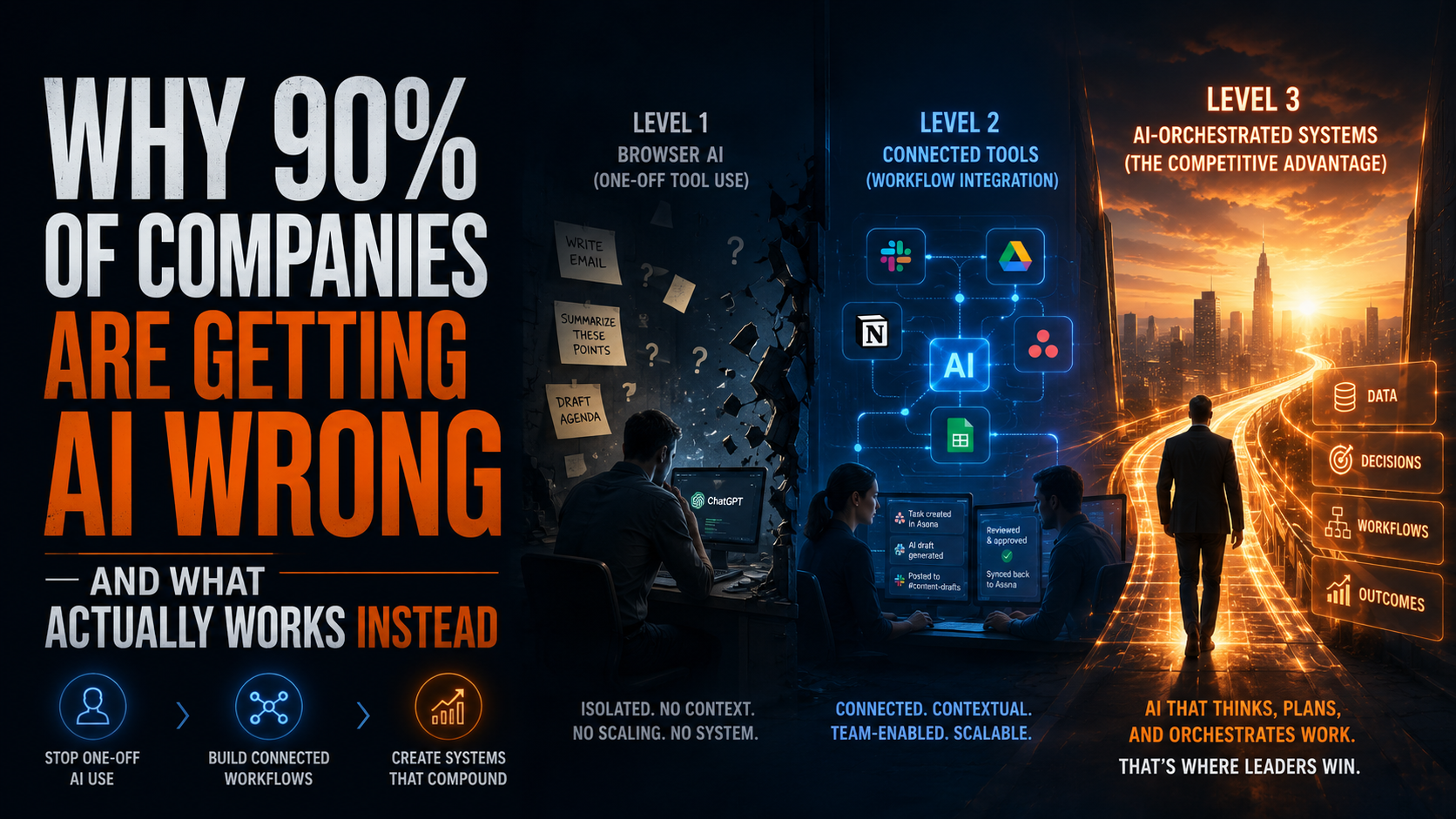
Why 90% of Companies Are Getting AI Wrong — And What Actually Works Instead
Here’s what I’ve watched happen across dozens of companies I’ve audited: A company signs up for ChatGPT, runs a pilot where someone uses it to draft emails faster, declares AI a success, and then… nothing. Six months later, adoption plateaus. Teams go back to old workflows. The software sits there like an expensive coffee machine nobody uses.
The frustrating part? It’s not because AI doesn’t work. It’s because most companies are using it all wrong.
Across 40+ B2B operations audits I’ve run, roughly 90% of companies are stuck at what I call Level 1. Not as a statistic from a research firm — as a pattern I keep seeing firsthand, across industries, company sizes, and tech stacks. A smaller group has moved to Level 2. Almost none have figured out Level 3 yet. But here’s the thing: Level 3 is where the real competitive advantage lives.
And if you’re stuck at Level 1, you need to know that moving to Level 2 isn’t hard — it just requires thinking about AI differently. Moving to Level 3 requires something else entirely: understanding how AI systems actually orchestrate work.
Let me break down each level, why companies stall, and what the upgrade actually looks like.
Level 1: Browser AI (One-Off Tool Use)
The Setup
Level 1 is ChatGPT in a browser tab. You open it, write a prompt, get an answer, copy-paste it somewhere, close the tab. Repeat tomorrow with a different prompt. No integration. No memory. No workflow connection.
What it looks like in practice:
- Marketing person prompts ChatGPT: “Write me three subject lines for a product launch email.”
- Sales rep uses Claude: “Summarize these 10 customer objections into themes.”
- Operations person asks Gemini: “Help me structure a process improvement meeting agenda.”
Each interaction is isolated. The AI has no context about the company, the customer, or the last decision made. You’re getting generic advice optimized for a generic prompt.
Why companies stay here
It’s the path of least resistance. No IT setup required. No integrations to manage. No training. You sign up, start prompting, and you immediately see a productivity bump on individual tasks. Someone writes emails 20% faster. A research project takes two hours instead of three.
That bump is real. But it’s also capped.
The ceiling you hit
Level 1 scales to exactly zero people other than the person using it. Your marketing team gets faster email drafts, but the sales team doesn’t benefit. Your entire company operates with AI, but nobody knows what anyone else is doing with it. There’s no institutional knowledge. If the person who figured out great prompts leaves, the company’s AI competency walks out the door with them.
There’s also no context. Every prompt starts from scratch. You can’t tell the AI “Here’s our brand voice, our customer segments, and our positioning” — because there’s no “here” to put it in. Each conversation is a stranger asking another stranger for advice.
And here’s the operational problem: you’ve got no idea where the AI is being used. Is someone using it to generate customer-facing copy without reviewing it? Is someone pasting confidential customer data into a public AI? At Level 1, you have no visibility and no control.
The Level 1 trap: It feels productive because individuals are more productive. But it’s not compounding. It’s not scaling. It’s not creating a system.
Level 2: Connected Tools (Workflow Integration)
The Setup
Level 2 is when you wire AI into the tools your business already uses. Slack. Asana. Notion. Google Workspace. Zapier. Make. n8n. The AI becomes part of the workflow, not a separate tool you context-switch into.
What it looks like in practice:
- A task is created in Asana → a Zapier integration triggers → it writes a first draft → posts it to a Slack channel → someone reviews and approves → it syncs back to Asana as a comment.
- A Google Form submission comes in → an n8n workflow triggers → AI extracts structured data → it either routes the lead to sales or updates a Notion database depending on the submission type.
- A customer support ticket arrives in Slack → an AI bot reads the ticket context → suggests three reply templates → the human picks one → it posts the response.
- An inbound lead fills out a discovery form → an n8n workflow triggers → AI scores the lead against your ICP criteria, pulls any existing CRM data, and drafts a personalized outreach email → the sales rep gets a Slack notification with the score, the draft, and a one-click approve button — all before they’ve had their morning coffee.
The Asana-Zapier-Slack pattern above is well-known and relatively straightforward to implement. But here’s a Level 2 example that trips people up more than they expect: using AI as a pre-processing layer inside your data pipeline before it ever reaches a human-facing tool. In one audit, a client was manually categorizing inbound vendor invoices before routing them for approval — a task taking a finance coordinator about four hours a week. We built an n8n workflow that pulled invoices from their email inbox, ran them through a structured extraction prompt to classify vendor type, flag anomalies against historical spend, and assign a confidence score, then pushed the results directly into their ERP system. The finance coordinator only touched the low-confidence flags. The catch nobody anticipated: the AI consistently misclassified one recurring vendor because the invoice formatting was non-standard. Without a confidence-threshold gate built into the workflow, those errors would have moved silently downstream. That failure mode — silent routing errors on edge-case inputs — is one of the most common ways Level 2 systems break in practice.
Why companies move here
Someone on the team figures out that Zapier integrations exist. Or Make. Or they prompt engineer a workflow in Notion. Suddenly, they realize: “Wait, I don’t have to copy-paste things. The AI can reach into my tools and work inside them.”
Adoption jumps. Multiple teams start using it. The initial person who set it up becomes the “AI person,” and now they’re building workflows for everyone else.
The ceiling you hit
Level 2 is transactional. It’s good for:
- Summarization (take messy input → structured output)
- Routing (if X condition, do Y)
- First-draft generation (create a starting point for human review)
- Data extraction (pull information out of unstructured content)
What it’s NOT good for:
- Complex reasoning across multiple steps
- Making judgment calls that require understanding context
- Learning from outcomes and adapting
- Handling exceptions or novel situations
A Level 2 system will always need a human to make the real decisions. That’s fine. That’s actually the right place for humans. But here’s where it breaks: if the workflow assumes a path that doesn’t exist (maybe a customer query doesn’t fit the three routing options you built), the whole thing stalls or goes sideways.
Also, Level 2 requires ongoing maintenance. Every integration is a point of failure. The more you build, the more fragile your system becomes.
The Level 2 truth: You’ve solved the context problem and the scaling problem, but you haven’t solved the reasoning problem. The AI is a better input-to-output converter, but it’s not thinking.
Level 3: Agentic AI (Orchestrated Reasoning)
The Setup
Level 3 is where AI actually becomes a team member. Not a tool that helps a person do their job. Not a workflow that processes transactions. An actual agent that can:
- Assess a situation independently
- Make decisions based on guidelines you’ve set
- Execute actions across your tools
- Learn from outcomes
- Ask for help when it’s out of its depth
In a Level 3 system, you have a chief-of-staff agent that orchestrates specialist agents. The chief-of-staff reads an incoming request, decides which specialist should handle it, briefs that specialist, and then synthesizes their output before passing it to a human for final approval — or directly executing if the confidence is high enough and the stakes are low.
This is a fundamentally different architecture from Level 2. Level 2 is a decision tree. Level 3 is a decision loop — the system reasons, acts, observes the outcome, and feeds that signal back into how it reasons next time. That feedback layer is what makes it genuinely adaptive rather than just faster.
What it looks like in practice
Let’s say you run a B2B agency. You have a Level 3 system. Here’s what happens when a new inbound lead comes in after hours:
- The chief-of-staff agent reads the inquiry.
- It pulls the lead’s company data from LinkedIn and your CRM, then cross-references your ICP scoring criteria.
- It routes the lead to the qualification specialist agent, giving it full context: company size, industry, stated problem, past touchpoints.
- The qualification specialist assesses fit across five dimensions — budget signals, authority, need, timeline, and strategic alignment — and produces a scored recommendation.
- If the lead scores above your threshold, the agent drafts a personalized response email, books a discovery call slot on the appropriate rep’s calendar, and creates a deal record in your CRM with pre-populated notes.
- If the lead is borderline, it flags it for a human with a full briefing document and a recommended next action.
- Either way, it logs the interaction, updates lead source attribution, and queues the lead in your nurture sequence if no immediate action is taken.
One inbound lead. Zero human involvement until the sales rep opens their morning Slack summary and finds a fully briefed pipeline update waiting for them. And the system is learning: every qualified lead that converts feeds back into how the qualification specialist weighs signals next time. That feedback loop is not incidental — it’s the core of why Level 3 compounds in a way that Level 2 never will.
Now let’s look at a second scenario. You run that same agency, but this time a client onboarding email arrives. The chief-of-staff recognizes the contract is signed and a new engagement is starting. It routes to the onboarding specialist, which automatically creates the project in your PM tool, assigns the templated task list, generates a customized welcome email with the client’s specific goals pulled from the sales notes, and schedules the kickoff call — all before your delivery lead has been notified that the deal closed.
This is not automation. This is delegation. The agent isn’t following a rigid if-then script. It’s reasoning about the situation and making judgment calls within boundaries you’ve defined. The distinction matters more than it sounds: automation breaks when reality doesn’t match the script. Delegation handles variance, because the agent is reasoning toward an outcome, not executing a path.
Why so few companies are here
Building Level 3 requires:
- Understanding agentic architecture (what is a chief-of-staff agent? What are specialist agents? How do they communicate?)
- Knowing how to structure prompts so agents can reason reliably
- Setting up memory and context systems so agents learn over time
- Building feedback loops that actually close — where outcomes update the criteria agents use to make decisions, not just log data nobody reads
- Building approval gates and exception handling so humans stay in the loop on high-stakes decisions
- Observing the system live and fixing the parts that fail
It’s not just a new tool. It’s a new way of thinking about work.
Most companies don’t have anyone on staff who understands this. The AI vendors don’t teach it — they’re busy selling Level 1 and Level 2. And the consultants who do understand it often charge $150K–$200K to set it up for you.
The Level 3 reality
Once a Level 3 system is built and stabilized, it’s not 20% faster at email drafts. It’s running entire operational functions with minimal human intervention. Routine decisions happen instantly. Edge cases get escalated with full context. Your best people spend their time on actual strategy instead of processing transactions.
And it’s hard to compete with that. If your competitor is qualifying leads, onboarding clients, and resolving support tickets at 5x your speed with more consistent decisions, that’s not a productivity gain. That’s a structural business advantage.
The companies that get there first aren’t just more efficient. They’re playing a different game.
Why This Matters: The Three Levels Aren’t Equal
Here’s the key thing to understand: these aren’t just “versions” of the same thing. They’re fundamentally different.
Level 1 makes individuals faster. The company doesn’t change.
Level 2 makes workflows faster. The company gets better at processing things but still depends on human decision-making for anything that’s not routine.
Level 3 changes what’s possible. The operational logic of the business starts to shift. Work that used to require headcount now requires architecture. Decisions that used to require manager attention now require exception handling. Some companies will figure this out in the next 18 months. The ones that don’t will spend the next five years wondering why they can’t keep up.
And this matters because adoption is accelerating. Your competitors are moving. They’re not all moving to Level 3 yet, but they’re moving. If you’re still at Level 1, you’re running out of runway.
The Question You Need to Answer
Where are you actually operating right now?
Be honest:
- Level 1: You’re using ChatGPT individually, maybe showing it to a couple of people, but there’s no system.
- Level 2: You’ve wired AI into Slack or Asana or your CRM. You have a few working automations. Multiple people use it, but it’s still mostly handling routine transactional stuff.
- Level 3: You have agents making decisions. Work is being executed without human intervention until it hits an exception. And the system is getting better over time because outcomes are feeding back into how it reasons.
If you’re at Level 1, the next move isn’t Level 3. It’s Level 2. Pick one workflow that’s repetitive and relatively low-stakes — lead routing, meeting summaries, support ticket triage. Build a simple integration. Test it. See what breaks. Learn from it.
If you’re at Level 2, the next move is harder. You need to start thinking about reasoning, not just routing. Where do you have decisions that could be delegated to an agent? Not executed by an agent — delegated. The agent assesses, recommends, and either executes or flags for you. That distinction matters. And when you’re ready to go deeper, the question to ask is: where in my operation do I have decisions that are repetitive enough to systematize but complex enough that a simple if-then rule keeps failing? That’s your Level 3 entry point.
If you’re at Level 3, you’re probably already thinking about what’s next: which feedback loops are actually closing, where your agents are still producing inconsistent outputs, and how to expand the scope of autonomous decision-making without increasing your exception rate.
The companies that figure out their level and move deliberately will pull ahead. The ones that stay at Level 1 forever will eventually wonder why their margins compressed and their best clients started getting faster, sharper service from someone else.